Homophones That Confuse Everyone: Their, There, They're and 50 More
January 20th, 2026
Homophones That Confuse Everyone: Their, There, They're and 50 More
Few spelling errors are more visible than homophone mistakes. You can spell accommodate perfectly, know every silent letter rule, and master every suffix pattern - but if you write "your the best" instead of "you're the best," readers notice immediately. Homophone errors jump off the page because they're not just spelling mistakes; they're word choice mistakes that change meaning, or at least reveal that the writer confused two words.
Homophones are words that sound identical but have different spellings and meanings. Their, there, and they're all sound the same when spoken, but they mean completely different things. Your and you're are pronounced identically but serve different grammatical functions. Accept and except differ by one sound that many speakers barely distinguish. These words cause confusion not because people don't know the difference in meaning, but because in the speed of writing, the brain grabs the wrong spelling.
The good news is that homophone mastery is achievable. Unlike silent letters or schwa vowels, homophones follow clear rules based on meaning. Once you connect each spelling to its specific meaning, the confusion dissolves. This guide covers the most commonly confused homophones in English - from the famous trio of their/there/they're to dozens of other pairs that trip up even native speakers - with clear explanations, memory tricks, and practice strategies.
Why Homophones Cause So Many Errors
Before diving into specific words, it's worth understanding why homophones are such a persistent challenge.
We Write Faster Than We Think
When typing or writing quickly, your brain processes meaning and lets your fingers (or pen) produce the spelling. But if two words share the same pronunciation, your motor memory might produce whichever spelling you've written more recently or more often, regardless of which meaning you intended. This is why even people who know the difference between their and there still mix them up in first drafts.
Spoken Language Hides the Problem
In speech, homophones are never confusing - context makes meaning clear. "I saw their house" and "I saw there, house on the left" are distinguished by phrasing and context. But in writing, the wrong spelling creates ambiguity or shows error. Writing reveals what speaking forgives.
Some Homophones Are Used Unequally
If you use your ten times for every one use of you're, your brain may default to the more common spelling even when you mean the contraction. Frequency effects are powerful, and less-used homophones get pushed out.
Autocorrect Can't Help (and Sometimes Hurts)
Autocorrect catches misspellings, not meaning errors. "Your welcome" is spelled correctly - both words exist - so autocorrect passes it through. This is why homophone errors survive into final drafts more often than traditional spelling errors.
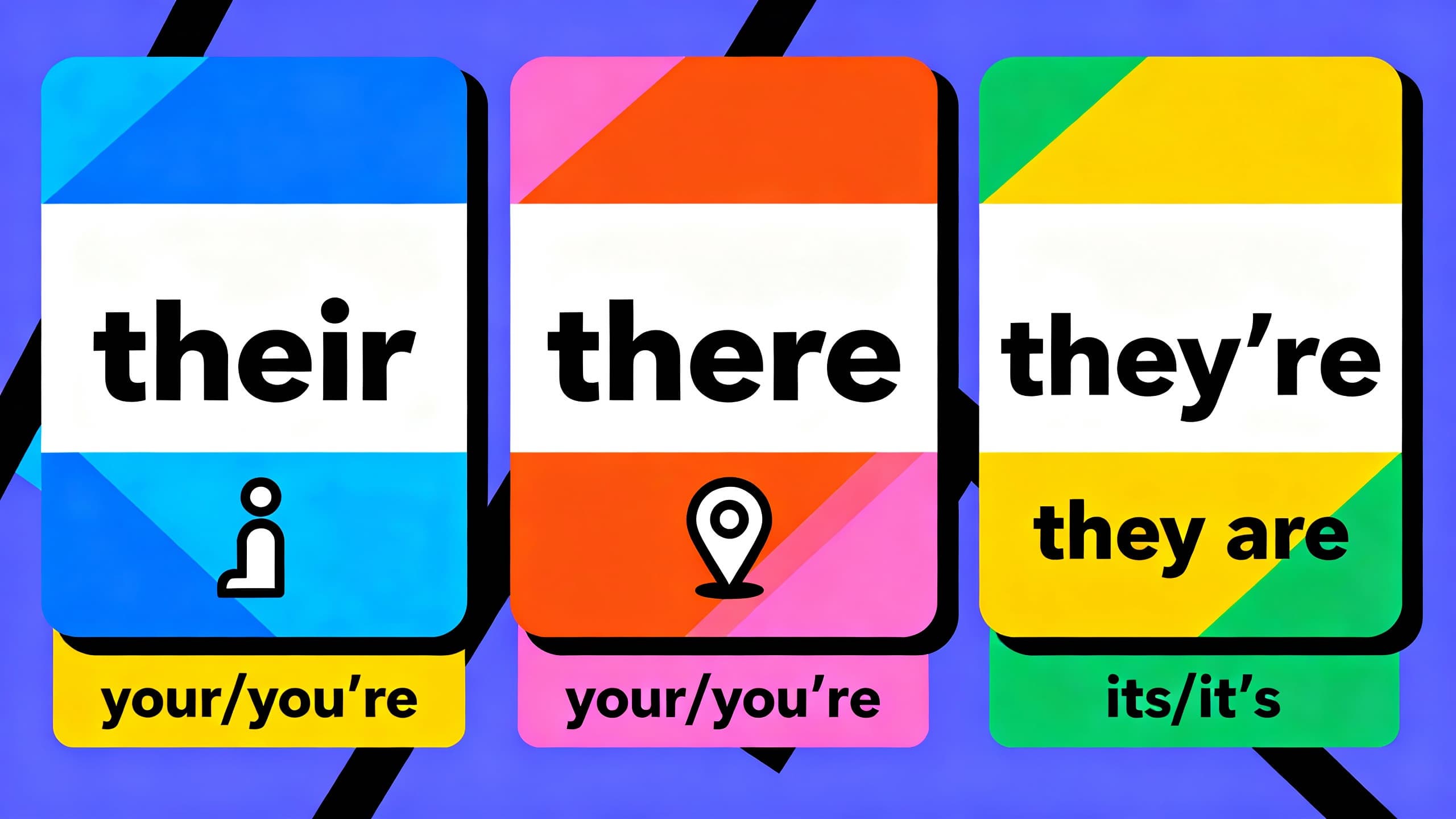
The Big Three: Their, There, They're
These three words are the most famous homophones in English, and they're confused constantly - by students, adults, native speakers, and English learners alike.
There
Meaning: A location or position; also used as an introductory word ("There are many options").
How to remember: There contains the word here. Both refer to location. "Here and there" = places.
Examples:
- Put the book over there.
- There is a problem with the order.
- We went there yesterday.
- There are three options.
Their
Meaning: Possessive form of "they" - something belongs to them.
How to remember: Their contains the word heir - someone who inherits (owns) something. Ownership = their.
Examples:
- Their house is beautiful.
- The students submitted their homework.
- I borrowed their car.
- The company changed their policy.
They're
Meaning: Contraction of "they are."
How to remember: The apostrophe replaces the missing letter "a" in "are." If you can substitute "they are," use they're.
Examples:
- They're coming to the party. (They are coming)
- I think they're wrong. (They are wrong)
- They're the best team. (They are the best team)
Quick Test
When you're unsure which to use:
- Can you replace the word with "they are"? → they're
- Does the word show ownership? → their
- Does the word refer to a place or introduce something? → there
Practice sentence (all three): They're going to leave their bags there.
Your vs. You're
This pair causes almost as much confusion as their/there/they're.
Your
Meaning: Possessive form of "you" - something belongs to you.
Examples:
- Is this your pen?
- Your idea is excellent.
- I'll wait for your call.
You're
Meaning: Contraction of "you are."
How to remember: Substitute "you are." If the sentence works, use you're.
Examples:
- You're welcome. (You are welcome)
- I think you're right. (You are right)
- You're the reason we won. (You are the reason)
Common Mistake
❌ "Your the best!"
✅ "You're the best!" (You are the best)
❌ "You're car is nice."
✅ "Your car is nice." (The car belongs to you)
Its vs. It's
This pair is tricky because the possessive form looks like it should have an apostrophe - but it doesn't.
Its
Meaning: Possessive form of "it" - something belongs to it.
How to remember: Think of his, hers, its - none of the possessive pronouns use apostrophes.
Examples:
- The dog wagged its tail.
- The company changed its name.
- The tree lost its leaves.
It's
Meaning: Contraction of "it is" or "it has."
How to remember: The apostrophe replaces the missing letter. Substitute "it is" to test.
Examples:
- It's raining. (It is raining)
- It's been a long day. (It has been)
- I think it's time to go. (It is time)
The Confusion
Many people add an apostrophe to possessives because apostrophe + s usually shows possession (John's book, the company's policy). But its is an exception - it's a possessive pronoun, like his, hers, yours, ours, theirs. None of those use apostrophes.
To, Too, Two
Three sounds-alike words with completely different meanings.
To
Meaning: Preposition indicating direction, purpose, or part of an infinitive verb.
Examples:
- I'm going to the store.
- She wants to learn French.
- Give it to me.
Too
Meaning: "Also" or "excessively."
How to remember: Too has "too many o's" - it means "excessive."
Examples:
- I want to come too. (also)
- It's too hot. (excessively)
- That's too expensive. (excessively)
Two
Meaning: The number 2.
Examples:
- I have two brothers.
- She arrived two hours ago.
- There are two options.
Accept vs. Except
These words differ by only one sound, and many speakers barely distinguish them.
Accept
Meaning: To receive, agree to, or believe.
How to remember: Accept = Accept = Agree (both start with A).
Examples:
- Please accept my apology.
- I accept your offer.
- She accepted the award.
Except
Meaning: Excluding, not including.
How to remember: Except = Exclude (both start with "ex").
Examples:
- Everyone came except John.
- I like all vegetables except broccoli.
- Except for the rain, it was perfect.
Affect vs. Effect
One of the most commonly confused pairs in English.
Affect
Meaning: (Verb) To influence or produce a change.
How to remember: Affect = Action (verb = action word).
Examples:
- The weather will affect our plans.
- How does this affect you?
- Stress affects sleep quality.
Effect
Meaning: (Noun, usually) The result or outcome; (Verb, rarely) to bring about.
How to remember: Effect = End result (noun = thing).
Examples:
- The effect was immediate. (noun)
- What are the effects of the medicine? (noun)
- The new law will take effect tomorrow. (noun)
- (Rare) They effected change. (verb = brought about)
The RAVEN Trick
Remember: Affect = Verb, Effect = Noun
This covers 90%+ of usage. Affect is almost always a verb; effect is almost always a noun.
Lose vs. Loose
These aren't pronounced identically by everyone, but they're confused in writing constantly.
Lose
Meaning: (Verb) To fail to keep, to not win.
Pronunciation: /luːz/ (rhymes with "choose")
Examples:
- Don't lose your keys.
- I don't want to lose the game.
- She tends to lose track of time.
Loose
Meaning: (Adjective) Not tight, not secure.
Pronunciation: /luːs/ (rhymes with "goose")
Examples:
- My shoelaces are loose.
- The dog got loose.
- That screw is loose.
Memory trick: Loose has more o's = more room = not tight.
Than vs. Then
Than
Meaning: Used for comparisons.
Examples:
- She's taller than me.
- This is better than that.
- I'd rather walk than drive.
Then
Meaning: Refers to time, or means "next" or "therefore."
Examples:
- I woke up, then had breakfast.
- Back then, things were different.
- If you agree, then sign here.
Memory trick: Then = time (both have "e" and relate to time). Than = comparison.
40 More Commonly Confused Homophones
Here's a comprehensive reference for other frequently confused pairs:
Words Commonly Used in Writing
| Word | Meaning | Example |
|---|---|---|
| brake | To slow/stop; device that stops | Hit the brake! |
| break | To damage; a pause | Take a break. |
| buy | To purchase | I'll buy lunch. |
| by | Near; indicates agent | Sit by me. Written by her. |
| bye | Goodbye | Bye for now! |
| capital | City; money; uppercase | London is the capital. |
| capitol | Building (US Congress) | Visit the Capitol building. |
| complement | To complete/enhance | Wine complements cheese. |
| compliment | To praise; praise | She gave me a compliment. |
| counsel | Advice; to advise; lawyer | Legal counsel advised waiting. |
| council | A group that meets/decides | The council voted. |
| desert | Dry land; to abandon | The Sahara Desert. / Don't desert me. |
| dessert | Sweet food after meal | I'll have dessert. |
| hear | To perceive sound | I can hear you. |
| here | This place | Come here. |
| hole | An opening | There's a hole in my sock. |
| whole | Complete, entire | I ate the whole thing. |
| know | To understand/be aware | I know the answer. |
| no | Negative | No, thank you. |
| lead | To guide (verb); a metal (noun) | She will lead the team. / Lead pipes. |
| led | Past tense of lead (verb) | She led the team yesterday. |
| pair | Two of something | A pair of shoes. |
| pear | A fruit | I ate a pear. |
| pare | To trim/peel | Pare the apple. |
| passed | Past tense of pass | She passed the test. |
| past | Previous time; beyond | In the past. / Walk past the store. |
| peace | Calm; absence of war | I need peace and quiet. |
| piece | A portion | A piece of cake. |
| plain | Simple; flat land | Plain language. / The Great Plains. |
| plane | Aircraft; flat surface | Board the plane. |
| principal | Head of school; main | The principal approved it. |
| principle | A rule/truth | It's a matter of principle. |
| right | Correct; direction; entitlement | That's right. Turn right. |
| write | To put words on paper | Write your name. |
| sight | Vision; something seen | A beautiful sight. |
| site | Location | The construction site. |
| cite | To reference | Cite your sources. |
| stationary | Not moving | The car was stationary. |
| stationery | Writing materials | Buy stationery for letters. |
| waist | Middle of body | Tie it around your waist. |
| waste | To squander; garbage | Don't waste water. |
| weather | Climate conditions | What's the weather like? |
| whether | If (introducing alternatives) | I don't know whether to go. |
| which | Referring to options/things | Which one do you want? |
| witch | A magical person | The witch cast a spell. |
| whose | Possessive of who | Whose book is this? |
| who's | Contraction of who is | Who's coming to dinner? |
Memory Strategies for Homophones
1. Connect Spelling to Meaning
The most reliable way to remember homophones is to link each spelling to its unique meaning:
- Stationery (paper) has "e" like envelope
- Stationary (not moving) has "a" like stand still
- Principal (head of school) is your "pal"
- Principle (a rule) is a rule
2. Create Memorable Sentences
Make sentences that highlight the meaning:
- "The principal is my pal."
- "I accept everything except onions."
- "Dessert is so good I want two (ss = extra sweet)."
3. Use the Substitution Test
For contractions, always substitute the full form:
- "You're welcome" → "You are welcome" ✓
- "Your coat" → "You are coat" ✗ (so use "your")
- "It's time" → "It is time" ✓
- "Its color" → "It is color" ✗ (so use "its")
4. Practice in Context
Writing homophones in sentences - not just looking at lists - builds practical memory. Create sentences that use both words from a pair:
- "They're putting their bags over there."
- "I won't accept any excuse except illness."
- "The weather determines whether we go."
5. Proofread Specifically for Homophones
In important writing, do a separate pass just for homophone errors. Search for common ones (their/there/they're, your/you're, its/it's) and verify each one is correct.
Homophones and Autocorrect
Modern spell-checkers don't catch most homophone errors because both spellings are "correct" - they're just correct for different meanings. This means:
- You can't rely on autocorrect for their/there/they're, your/you're, etc.
- Grammar checkers are better (Grammarly, ProWritingAid, Microsoft Editor) at catching these because they analyze context
- Human proofreading is still essential for important documents
FAQ: Common Homophone Questions
"Why do I keep making these mistakes even though I know the difference?"
Speed is the culprit. When writing quickly, your brain processes meaning faster than it controls spelling. Your motor memory defaults to the most common or most recent pattern. Slow down for important writing, and always proofread specifically for homophones.
"Should I worry about homophone errors in casual texts?"
In texts to friends, minor errors usually don't matter. But if you're texting professionally or want to maintain a reputation for precision, it's worth checking. Many people do notice.
"Are there homophones that native speakers NEVER mix up?"
Almost never. Even the clearest pairs (like "I" vs. "eye") occasionally get confused by fast typists. The difference is frequency - "their/there/they're" errors are common because all three are high-frequency words used in similar contexts.
"Do British and American English have different homophones?"
Yes, slightly. Some words are homophones in one accent but not another. For example, "Mary/marry/merry" are pronounced identically by most Americans but distinctly by many British speakers. "Caught/cot" are homophones in some American accents but not in British English.
Practice Exercises
Exercise 1: Fill in the Blanks
Choose the correct word:
- _______ going to the store later. (Their / There / They're)
- Is that _______ car? (your / you're)
- The dog lost _______ collar. (its / it's)
- This is _______ hot to eat. (to / too / two)
- The music will _______ your mood. (affect / effect)
- Don't _______ your keys! (lose / loose)
- She's smarter _______ he is. (than / then)
- Everyone came _______ Maria. (accept / except)
Answers: 1. They're, 2. your, 3. its, 4. too, 5. affect, 6. lose, 7. than, 8. except
Exercise 2: Write Sentences
Write one sentence correctly using each of these pairs:
- their / there / they're
- peace / piece
- principal / principle
- weather / whether
- passed / past
Your Homophone Mastery Plan
Week 1: The Big Four
Focus on: their/there/they're, your/you're, its/it's, to/too/two Practice: Substitution tests, write sentences using all forms
Week 2: Common Pairs
Focus on: accept/except, affect/effect, than/then, lose/loose Practice: Create memory links, write in context
Week 3: Expand Your List
Focus on: passed/past, principal/principle, stationary/stationery, and 5-10 more from the table Practice: Use in professional or academic writing contexts
Week 4: Review and Real Writing
Apply homophone awareness to your actual writing. Proofread emails, reports, and messages specifically for homophone errors.
For a complete daily practice routine: The 10-Minute Daily Spelling Practice Routine
Conclusion: Homophones Are About Meaning, Not Sound
The challenge with homophones isn't spelling in the traditional sense - it's linking the right spelling to the right meaning. Unlike words with silent letters or unusual patterns, homophones follow clear rules once you know which word you want.
The strategy is simple:
- Know the meaning of each word in a homophone pair
- Create memory links that connect spelling to meaning
- Use the substitution test for contractions (you're = you are, it's = it is)
- Proofread specifically for homophones in important writing
- Practice in context - sentences, not just word lists
Homophone errors are among the most noticed mistakes in writing because they suggest confusion between words, not just uncertain spelling. But they're also among the most fixable. Once you connect each spelling to its meaning, the errors stop.
Start with the words that trip you up most often. Master those. Then expand. Within a few weeks, you'll find that the right spelling comes automatically - because you're not just remembering spellings, you're choosing meanings.
Related Reading on Spelling.School
-
The 7 Most Important English Spelling Patterns Every Learner Should Know
-
Why Adults Struggle With Spelling (And How to Fix It in 10 Minutes a Day)
-
The Science of Spelling: How Spaced Repetition Boosts Memory
-
15 Spelling Mistakes That Make You Look Unprofessional at Work
-
Silent Letters in English: A Complete Guide to Words You Can't Sound Out
-
British vs American Spelling: The Complete Guide (And Which One to Use)
-
How to Prepare for TOEFL Spelling: The Words That Trip Up Test-Takers
-
The Most Common English Spelling Mistakes Spanish Speakers Make (And How to Fix Them)
-
The Most Common English Spelling Mistakes Chinese Speakers Make (And Memory Tricks That Work)