Do Kids Still Need to Learn Spelling in the Age of AI? (Yes - and Here's Why It Matters More Than Ever)
December 4th, 2025
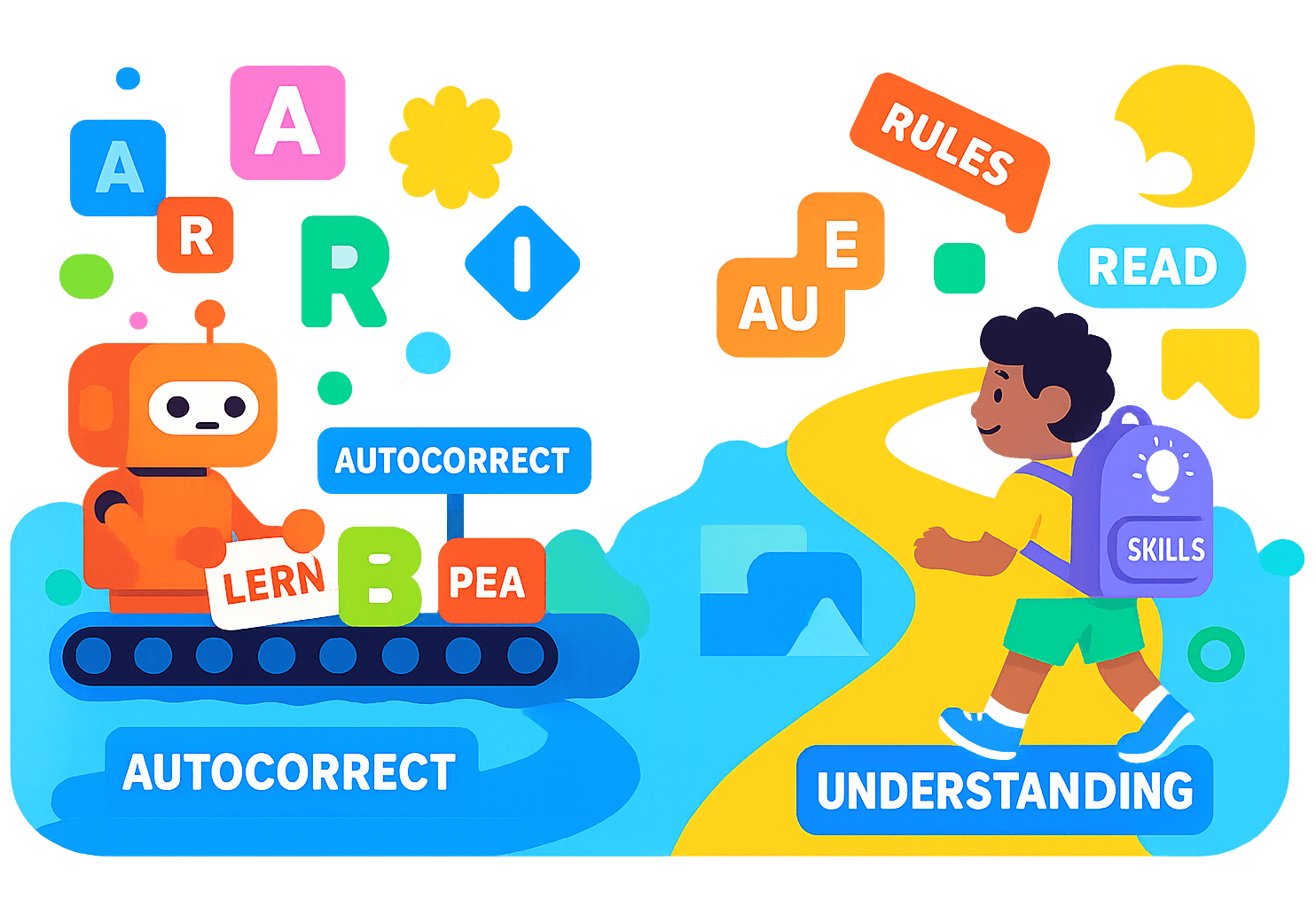
Not long ago, spelling well was considered a basic part of being educated. Kids memorized lists, took weekly tests, copied words over and over, and were expected to master the patterns of English by sheer repetition. But now? We have autocorrect, AI writing tools, predictive text, Grammarly, speech-to-text, and every digital helper imaginable. Kids can type a word wrong and watch it magically fix itself. Adults can write emails without thinking twice about how a word is spelled. Phones and laptops quietly patch our mistakes all day long.
So it makes sense that many parents (and even teachers) wonder: "Does spelling still matter? Should kids still learn to spell when AI can fix everything?"
It's an honest question - and a surprisingly urgent one. We're raising a generation in a world where technology does a lot of the work for them, and it's easy to assume spelling is slowly becoming obsolete. But spelling isn't just about getting letters in the right order. It's about something much deeper: clarity, confidence, reading fluency, vocabulary, meaning-making, and the ability to communicate ideas precisely in a world that's overflowing with text.
And here's the truth: Spelling matters now just as much as it ever did - maybe even more. But the way we teach it needs to change.
Let's break it down.
AI Can Fix Mistakes - But It Can't Read Your Mind
AI can autocorrect a word. It can suggest alternatives. It can smooth out grammar. It can even rewrite an entire paragraph for clarity. But AI still has no idea what you meant to say. It doesn't know your intention, your nuance, your voice, or your exact thought process.
If a child types "principle" when they actually mean "principal," AI won't always catch that. If a teen writes "affect" when they meant "effect," AI might not know the difference. If a student writes something confusing, an algorithm can polish it - but it can't reconstruct the idea they never learned to express clearly.
Spelling is tied to meaning. Meaning is tied to writing. Writing is tied to thinking.
AI helps with spelling, but it cannot replace the cognitive foundation behind it.
Clear Writing Is Still One of the Most Powerful Skills a Person Can Have
Even in 2025, most professional communication still happens through writing. Emails, reports, Slack messages, assignments, applications, chat conversations, creative work, and documentation all require clear, confident writing. Whether we like it or not, people judge competence through text. Clean, confident writing - which includes spelling - gives an immediate impression of clarity and reliability. Kids who grow up able to express themselves well on paper have an enormous advantage later in life. Not because their spelling makes them "smart," but because clear writing makes their ideas impossible to ignore.
If a hiring manager reads an email full of errors, they don't say, "Wow, technology must have glitched." They assume the writer wasn't paying attention. Sometimes that's unfair - but it's real.
AI tools can polish your writing, but the world still expects the ideas behind the writing to be yours.
Real-Time Writing Still Exists - and Tools Can't Always Help
Kids don't spend their whole lives typing into ChatGPT. They still take notes in class, write on whiteboards, fill out forms, and answer questions on paper. They draft rough ideas, scribble reminders, work through math word problems, write essays without internet access, and brainstorm ideas in notebooks. Those moments require actual spelling knowledge. They're fast, human, imperfect moments - and relying entirely on AI doesn't help there.
A child who doesn't understand spelling patterns gets stuck every time they have to write something without a computer nearby. They hesitate. They second-guess. They avoid more advanced words. That hesitation shapes their confidence for years.
Even adults know the feeling: that micro-moment of panic when you need to write "separate" or "necessary" in front of people. Kids feel that too - and more intensely. This is exactly why adults struggle with spelling - those moments of uncertainty never fully go away without solid spelling knowledge.
Spelling and Reading Are Connected (This Is the Big One Parents Don't Know)
If you've ever wondered why spelling practice matters even if kids won't be writing essays with quills and ink, this right here is the answer: Spelling is a reading skill.
When kids learn spelling patterns - long vowels, r-controlled vowels, suffixes like -tion, common tricky words like because and friend - they're not just learning to write better. They're learning to decode faster, recognize words quicker, and read more fluently. Strong spelling knowledge helps kids process words automatically, recognize letter patterns instantly, and understand how words are built. It also helps them read unfamiliar words more easily, expand their vocabulary, and understand meaning and nuance. These are the same spelling patterns every learner should know - and they're just as important for reading as they are for writing.
Spelling strengthens the same neural pathways used for reading. If your child struggles with spelling, chances are they're quietly struggling with reading speed or confidence too.
AI can correct spelling. AI cannot build the reading circuits in a child's brain.
Good Spelling Prevents Confusing - Even Dangerous - Miscommunication
Many word pairs look similar but have completely different meanings: accept vs. except, adapt vs. adopt, desert vs. dessert, site vs. sight, affect vs. effect, principal vs. principle, brake vs. break, and compliment vs. complement. AI sometimes catches these - and sometimes doesn't. When a child types "principle" but means "principal," or confuses "affect" with "effect," the meaning shifts completely. Kids who rely entirely on autocorrect may learn to trust the machine more than their own understanding, and that creates confusion later. When writing becomes ambiguous, meaning becomes blurry.
Precision matters - in school, in work, in negotiations, in instructions, in safety, and in everyday life. Spelling is part of that precision. For more examples of these tricky word pairs and memory tricks to remember them, see our guide to commonly misspelled words.
The AI Paradox: The More AI We Have, the More Human Skills Matter
Here's something most people don't see coming: AI doesn't eliminate the need for good writing. AI makes good writing more valuable.
Why? Because AI makes basic writing extremely easy and extremely cheap. Millions of people will produce the same AI-sounding text, with the same tone, the same mistakes, the same "good enough" level of clarity. It becomes noise.
Human writing - thoughtful, confident, clear, personal - becomes the signal.
Kids who can think clearly, write independently, and spell instinctively rise above the noise. They express precise ideas, use vocabulary well, and revise their own work with confidence. AI becomes a tool for them, not a crutch.
Spelling is part of that foundation - a small piece of a much bigger skill: effective communication in a world full of automated text.
Confidence Is the Hidden Reason Spelling Still Matters
This might be the most important reason of all, but it's rarely discussed.
Kids who struggle with spelling often avoid challenging words, write shorter and simpler sentences, hesitate before putting ideas on paper, feel embarrassed about mistakes, lose confidence in their writing voice, and assume they're "bad at English" even when they're not.
The impact is real, and it shapes how kids see themselves as writers.
And the opposite is true too: Kids who learn spelling patterns begin to take risks with longer words, write more creatively, participate more in class, express themselves with more personality, and actually enjoy writing.
Spelling isn't about perfection. It's about freedom - the freedom to write boldly without fear.
AI can't give kids that. Only mastery of the language can.
So What Should Spelling Instruction Look Like Today? (Hint: Not What We Grew Up With)
Spelling shouldn't be about memorizing long lists and taking tests that never transfer into real writing. That old system didn't work in the 80s, and it definitely doesn't work now.
Modern spelling instruction should be short, focused, meaningful, pattern-based, connected to reading, connected to writing, rooted in spaced repetition, and based on actual tricky words kids struggle with. Kids don't need more busywork. They need a system that matches how their brains learn and remember words.
This is exactly what our 10-minute daily spelling practice routine is designed to do - short sessions that build real mastery without overwhelming kids or parents.
Where Spelling.School Fits Into the Modern World
This is exactly why I built Spelling.School. Kids today don't need more worksheets or random weekly lists. They need the right words at the right time, spaced review that keeps words from slipping away, and pattern-based teaching that helps them understand why words are spelled the way they are. They need short daily practice sessions, a gentle and encouraging approach that removes shame, and progress that builds real confidence.
Spelling.School takes everything research supports - spaced repetition, active recall, morphology, high-frequency patterns - and makes it automatic for families. Kids do a few minutes of focused practice. The system handles the hard part.
AI helps polish writing. Spelling.School helps kids build the skill behind the writing. For parents exploring spelling tools, our guide to the best spelling apps for kids reviews how technology can support spelling practice, and our guide for busy parents offers practical strategies that work alongside modern spelling tools.
Conclusion: Tools Help - But Skills Last a Lifetime
Technology is changing fast, but one thing hasn't changed: Kids still need the ability to express themselves clearly, confidently, and independently.
AI can correct mistakes. AI can polish sentences. AI can offer suggestions. But AI cannot replace the thinking skills behind strong writing - the vocabulary, the structure, the clarity, the patterns, the meaning, the confidence.
Spelling isn't about passing a test. It's about building a foundation kids will rely on their entire lives.
And the beautiful truth is: spelling doesn't have to be stressful, boring, or overwhelming. When taught the right way - short, frequent, meaningful sessions with a focus on real patterns - spelling becomes a manageable, empowering part of literacy.
In the age of AI, literacy still matters. Communication still matters. Confidence still matters. Spelling still matters.
And your child can master it in minutes a day.